Meteorological environment monitoring equipment supplier
Insist on doing high-precision customer favorite technology products

Meteorological environment monitoring equipment supplier
Insist on doing high-precision customer favorite technology products

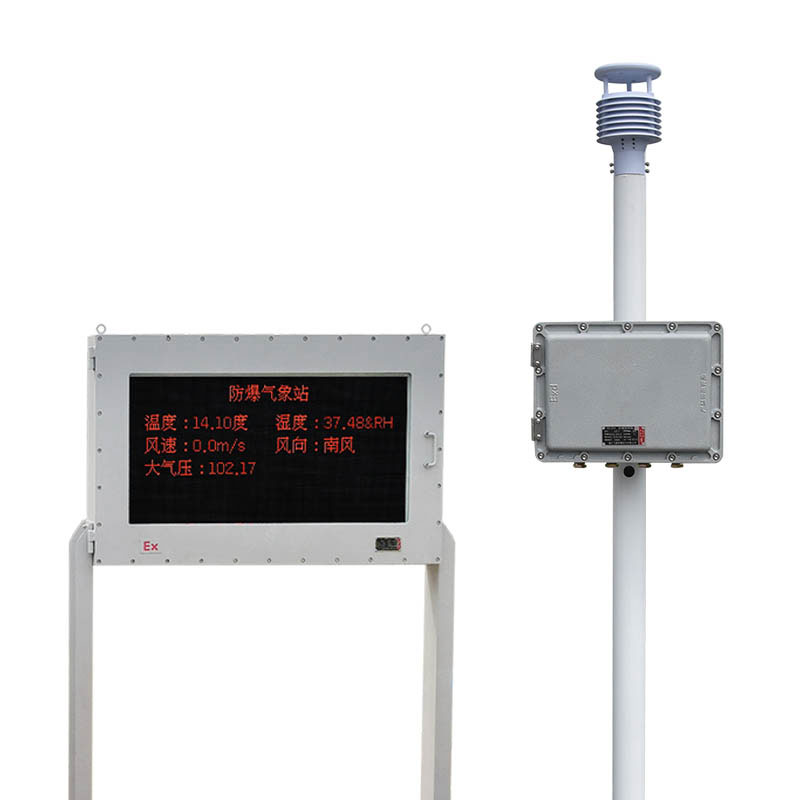
Mining Weather Station features a high-protection design including corrosion resistance, explosion-proof, waterproof, shockproof, and dustproof, meeting the needs of chemical plants, oil depots, mines, and other similar environments. The equipment has passed national explosion-proof standard certification, effectively preventing explosions caused by electrical sparks and high temperatures.
Mining Weather Station is a professional meteorological monitoring device designed for flammable and explosive locations such as chemical plants, oil depots, tunnels, and mines. Its main function is to monitor key meteorological parameters such as wind speed, wind direction, air temperature, humidity, and atmospheric pressure in real time, providing data support for production scheduling, safety early warning, and emergency response.
Regarding explosion-proof performance, the equipment strictly adheres to national explosion-proof electrical equipment standards, with specially designed housings and connectors. The equipment employs intrinsically safe explosion-proof technology, limiting circuit energy to ensure that no ignition sparks are generated in fault conditions. The casing is primarily constructed of cast aluminum or 304 stainless steel, with explosion-proof sealing rings at key joints to effectively prevent external flammable gases from entering the equipment. Manufacturers typically provide high-level explosion-proof certificates such as Ex ia IIC T6 Ga and comply with the relevant requirements of the GB3836 series standards.
Structurally, this weather station features five protective characteristics: corrosion resistance, explosion-proof, waterproof, shockproof, and dustproof. The sensor probes typically employ a top-cover concealed design, using ultrasonic principles instead of traditional mechanical anemometers to avoid rain and snow accumulation and mechanical wear, while also reducing interference from natural wind on the measurement results. The outer shell is primarily made of ASA engineering plastics or 304 stainless steel, possessing corrosion and oxidation resistance properties, enabling it to withstand harsh industrial environments.
For space-constrained locations such as industrial workshops and small factories, the equipment adopts an integrated structural design, resulting in a compact size and easy installation and disassembly. For data transmission, it supports wired protocols and can be directly connected to the PLC or DCS system in the control room. Some models also support 4G wireless transmission, enabling data to be uploaded to a cloud platform for remote management and multi-department data sharing. The system has low power consumption; some models can control the overall power consumption to around 2.0W, demonstrating good energy-saving characteristics.
Sales Manager:Ms. Emily Wang
Tel, Whatsapp:+86 15898932201
Email:info@fengtutec.com
Add:No. 155 Optoelectronic Industry Accelerator, Gaoxin District, Weifang, Shandong, China