Meteorological environment monitoring equipment supplier
Insist on doing high-precision customer favorite technology products

Meteorological environment monitoring equipment supplier
Insist on doing high-precision customer favorite technology products

scenic weather station employs a cylindrical electrode aspiration principle to precisely measure the concentration of negative oxygen ions in the air, 24 hours a day. The device offers expandability to monitor various meteorological parameters—such as temperature, humidity, PM2.5 levels, wind speed, and wind direction—making it ideally suited for deployment in tourist attractions, eco-estates, wetland parks, and nature reserves.
scenic weather station is a stationary environmental monitoring device primarily designed for the real-time surveillance of negative oxygen ion concentrations and associated meteorological factors. Utilizing a cylindrical electrode aspiration measurement principle, the device features a negative oxygen ion measurement range of 0 to 100,000 ions per cubic centimeter, with a measurement accuracy of ±10% and a resolution precise to 1 ion per cubic centimeter. This technological solution enables the rapid capture of even subtle fluctuations in airborne negative oxygen ion levels, thereby providing robust data support for comprehensive air quality assessments.
Beyond its core monitoring capabilities, this monitoring station boasts significant expandability. Depending on the specific requirements of the application scenario, users can add monitoring modules for air temperature, humidity, PM2.5, PM10, atmospheric pressure, oxygen content, noise levels, wind speed, and wind direction. When combined with the negative oxygen ion data, these expanded parameters form a holistic system for evaluating environmental quality. The sensors feature an integrated, solid-state design—free of mechanical moving parts—ensuring high precision and a long operational lifespan; the unit is capable of stable operation within a wide temperature range of -40°C to +60°C.
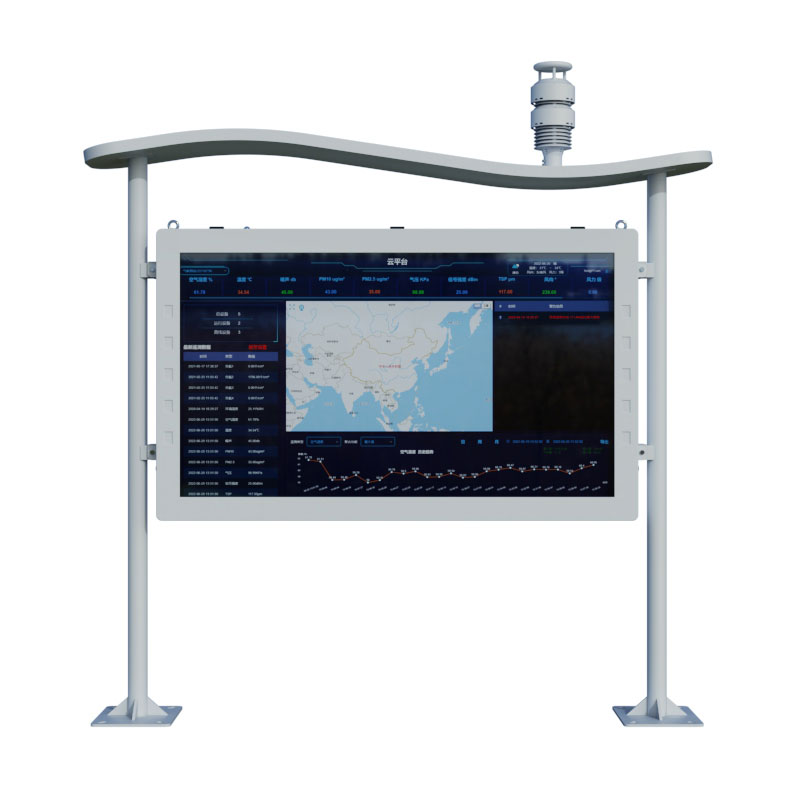
Regarding data transmission and management, scenic weather station supports multiple communication protocols, including wireless GPRS, 4G cellular transmission, and fiber-optic connectivity. Monitoring data is uploaded to a cloud-based platform in real-time, allowing users to remotely access and view the data via either a PC or a mobile device. Additionally, the unit is equipped with an on-site full-color LCD screen that displays real-time data and facilitates historical data storage; a single unit can store up to one year's worth of raw monitoring data locally.
The design of scenic weather station takes into full account the complexities inherent in outdoor deployment. The main structural chassis is constructed from carbon steel and features composite sealing strips to ensure multi-angle waterproofing protection. The base of the device is fitted with a filtration mechanism capable of filtering out dust particles larger than 5μm; this dust-proof design facilitates the quick and easy replacement of filter media directly on-site. Furthermore, the unit incorporates internal lightning protection circuitry and a leakage current protector to ensure safe and reliable operation, even during thunderstorms or adverse weather conditions. In terms of practical application, scenic weather station has already been deployed across a wide range of settings. In tourist attractions, eco-estates, wetland parks, forest parks, and nature reserves, this device provides essential data support for environmental quality assessments and the certification of "natural oxygen bars." At Dengjiahe Park in Xiaogan, Hubei, a smart environmental monitoring system transmits real-time environmental data—including negative oxygen ion concentrations—to a central management backend, allowing citizens to access this information directly via their mobile phones. On the Qinghai Plateau, meteorological authorities have established fixed-site negative oxygen ion observation stations; by integrating this data with standard meteorological readings, they have developed a comprehensive monitoring and forecasting system for both oxygen levels and negative oxygen ion concentrations. At Zhenhu National Wetland Park in Jiayu, Hubei, an integrated eco-meteorological monitoring station conducts round-the-clock surveillance of negative oxygen ion levels and various meteorological parameters, thereby filling a critical gap in local atmospheric negative oxygen ion monitoring capabilities. These case studies demonstrate that scenic weather station provides effective technical support for ecological conservation, tourism development, and precision meteorological services.
Sales Manager:Ms. Emily Wang
Tel, Whatsapp:+86 15898932201
Email:info@fengtutec.com
Add:No. 155 Optoelectronic Industry Accelerator, Gaoxin District, Weifang, Shandong, China