Meteorological environment monitoring equipment supplier
Insist on doing high-precision customer favorite technology products

Meteorological environment monitoring equipment supplier
Insist on doing high-precision customer favorite technology products

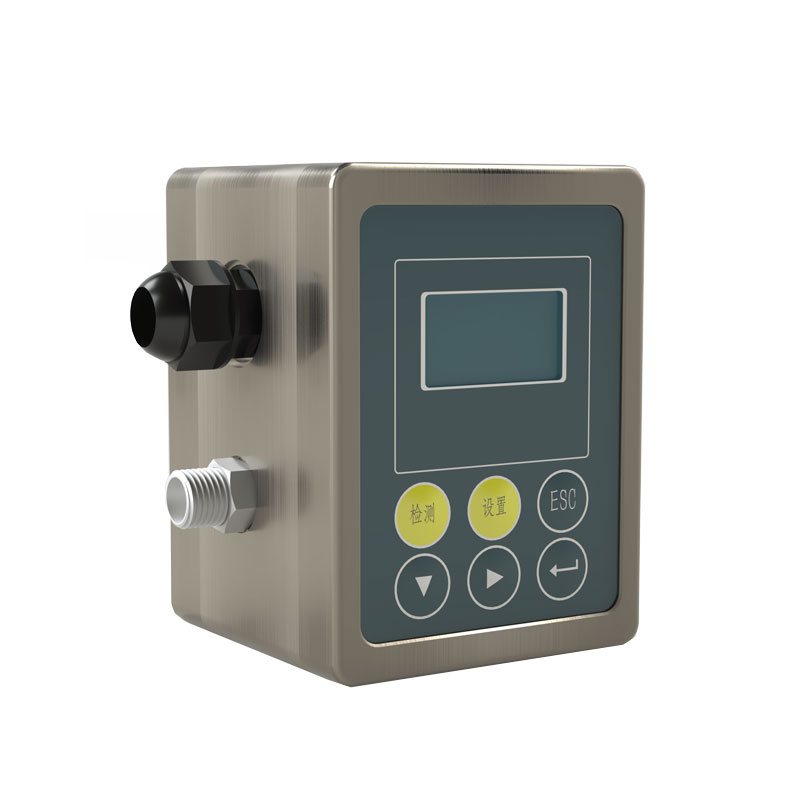
1、Oil cleanliness sensor Product Introduction
Oil cleanliness sensor uses photoresist method to quickly and accurately detect oil contamination levels and output particle count and contamination level.Oil cleanliness sensor uses the Light Extinction method (also known as the extinction method or light obscuration method) specified in ISO 4402/ISO 11171 for oil contamination detection. It offers advantages such as fast detection speed, strong anti-interference capability, high accuracy, and good repeatability.
A parallel light beam passes perpendicularly through a sample flow chamber with a cross-sectional area of A and illuminates a photodetector. When there are no particles in the liquid flow, the circuit outputs a voltage of E. When a particle with a projected area of a passes through the sample flow chamber, it blocks the parallel light beam, causing attenuation of the transmitted light. At this time, a negative pulse with an amplitude of E。 is output on the circuit: E。=(a/A)×E. If the particle is spherical, or described by an equivalent diameter d, and E equals 10V, then E。=7.854×d2/A. That is, the projected area of the particle and the pulse voltage amplitude have a linear relationship.
2、Oil cleanliness sensor Features
Utilizing the light-blocking method (light obstruction method), it incorporates particulate contamination level standards such as GJB420B-06, GJB420A-96, NAS1638, and ISO4406:1999 (GB/T14039-2002), providing real-time particle count and contamination level information for the tested sample.
It can be calibrated according to ISO4402 or ISO11171.
It features a standard RS485 serial interface for connecting to an external computer for control and result storage.
Results can be stored via an external USB flash drive (optional).
Real-time data allows for real-time monitoring and analysis of wear trends in hydraulic systems.
3、Oil cleanliness sensor Application areas
Oil cleanliness sensor system, developed using the light-blocking method (optical obstruction method), is used for online real-time monitoring of particulate contamination in hydraulic system oil circuits. It can be widely applied in aviation, aerospace, power, petroleum, chemical, transportation, port, metallurgy, machinery, and automobile manufacturing fields for the detection of solid particulate contamination in hydraulic oil, lubricating oil, transformer oil (insulating oil), turbine oil, gear oil, engine oil, aviation kerosene, and water-based hydraulic oil, as well as for the detection of particulate impurities in organic liquids and polymer solutions.
4、Oil cleanliness sensor Technical parameters
Light source: Semiconductor laser;
Detection range: 1–100 μm or 4–70 μm (C);
Sensitivity: 1 μm (ISO4402) or 4 μm (C) (ISO11171, GB/T18854-2002);
Measurement channels: Built-in standards GJB420A-96, GJB420B-06, NAS1638, ISO4406, etc.;
Particle size: 1µm, 2µm, 5µm, 10µm, 15µm, 25µm, 50µm, 100µm; 4µm(c), 4.6µm(c), 6µm(c), 10µm(c), 14µm(c), 21µm(c), 38µm(c), 7µm(c) 0µm(c),
Test accuracy: ±0.5 contamination levels;
Online pressure: 0~10MPa; 0~40MPa (with pressure reducing valve);
Detection flow rate: 50~300mL/min;
Oil temperature: <80℃;
Ambient temperature: -30℃~60℃;
Storage temperature: -55℃~85℃
Power supply: DC 9-30VDC, 1000mA;
Instrument dimensions: 100mm×75mm×71mm (L x W x H);
Humidity: Operates at relative humidity of 20%~85%, non-condensing; storage humidity 98%;
Interface type: Standard high-pressure hose; optional low-pressure ferrule hose with inner diameter 4mm and outer diameter 6mm.
Sales Manager:Ms. Emily Wang
Tel, Whatsapp:+86 15898932201
Email:info@fengtutec.com
Add:No. 155 Optoelectronic Industry Accelerator, Gaoxin District, Weifang, Shandong, China












 Get a Free Quote